
Extruded Aluminium Profiles for Facades: Technical Specifications, Performance & Architectural Applications
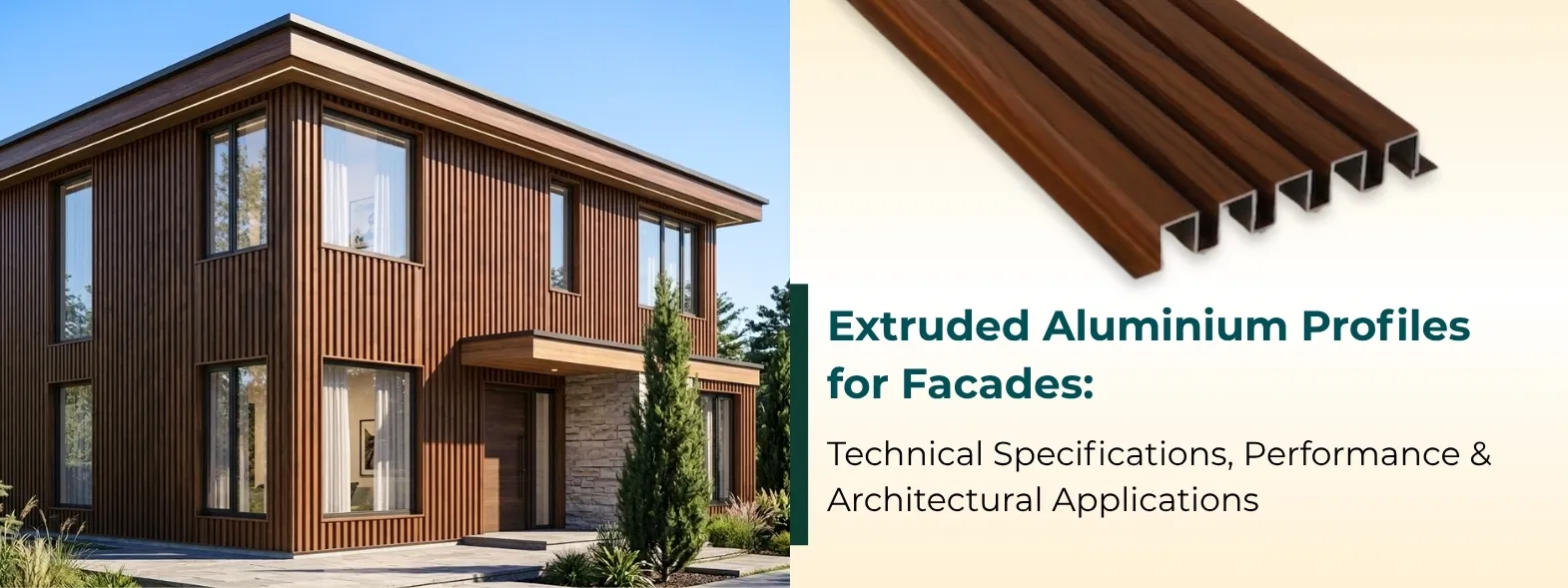
In façade engineering, the difference between a visually appealing building and a high-performing envelope lies in system design and detailing precision. While cladding materials often receive primary attention, the underlying structural framework, particularly extruded aluminium profiles, is what ultimately governs alignment, load transfer, and long-term performance.
As façade systems in India evolve toward unitized assemblies, ventilated rainscreens, and parametric skins, extruded aluminium profiles have become indispensable. Their ability to deliver dimensional accuracy, repeatability, and design adaptability makes them a critical component in contemporary aluminium facade systems.
What Are Extruded Aluminium Profiles in Facade Systems?
Extruded aluminium profiles are engineered components produced by forcing aluminium alloy through a precision die to achieve a defined cross-sectional geometry.
In façade applications, these profiles function as:
- Primary and secondary structural members
- Panel support rails and brackets
- Mullions and transoms in curtain wall systems
- Edge, joint, and transition elements
They form the load-bearing and alignment framework that supports aluminium facade panels, glazing systems, and other cladding materials.
It is important to note that profile performance is not standalone. It depends on:
- Alloy selection
- Profile geometry and thickness
- Surface treatment
- Installation detailing within the overall façade system
Aluminium Extrusion Process: Engineering Precision at Scale
The extrusion process enables the production of profiles with tight tolerances and consistent mechanical properties, which are essential for façade applications.
Billet Heating
Aluminium billets, typically from the 6000 series (such as 6063 or 6061), are heated to a plastic state suitable for forming.
Extrusion Through Die
The billet is forced through a die that defines the final cross-section. This allows complex geometries, including hollow and multi-cavity profiles.
Quenching and Cooling
Controlled cooling ensures the required metallurgical properties and dimensional stability.
Stretching and Straightening
Profiles are mechanically stretched to remove internal stresses and ensure linear accuracy.
Surface Finishing
Profiles are treated with finishes such as:
- Anodizing (for corrosion resistance and durability)
- Powder coating (for uniform color and protection)
- PVDF coating (for high-performance façade applications)
The result is a product that combines structural capability with architectural finish quality.
Material Specifications & Standards
For façade applications, extruded aluminium profiles are generally manufactured using:
- Alloy Series: 6000 series (Al-Mg-Si alloys)
- Common Grades: 6063-T5, 6063-T6, 6061-T6
- Key Properties:
- Good extrudability
- Moderate to high strength
- Excellent surface finish quality
- Corrosion resistance
Specification should align with relevant standards such as:
- Bureau of Indian Standards (BIS) codes
- ASTM standards for aluminium alloys
- Project-specific façade performance criteria
Selection must be based on structural calculations, wind load requirements, and system design, not just availability.
Types of Extruded Aluminium Profiles in Facade Systems
Structural Profiles
These are primary load-bearing members designed to transfer wind loads and dead loads from the façade to the building structure.
Mullions and Transoms
Used in curtain wall systems, these profiles create the grid that supports glazing or panels. Their design must account for deflection limits and load distribution.
Rainscreen Support Profiles
In ventilated façade systems, profiles act as brackets and rails that support aluminium panels while maintaining a cavity for airflow and drainage.
Edge and Closure Profiles
These ensure proper termination at corners, joints, and transitions, preventing water ingress and maintaining visual continuity.
Custom Extruded Profiles
Custom profiles are increasingly used in advanced façade systems.
They allow:
- Integration of fixing mechanisms within the profile
- Reduction of secondary components
- Improved installation efficiency
- Accommodation of complex geometries
However, their effectiveness depends on proper design validation and fabrication control.
Structural & Performance Advantages
High Strength-to-Weight Ratio
Aluminium provides structural strength with significantly lower weight compared to steel, reducing load on the primary structure.
Dimensional Accuracy
Extrusion ensures consistent cross-sections, which is critical for façade alignment and tolerance control.
Corrosion Resistance
Aluminium offers inherent corrosion resistance due to its oxide layer. This can be further enhanced through anodizing or protective coatings, particularly in coastal or high-pollution environments.
Thermal Considerations
Aluminium is a conductive material; therefore, thermal performance depends on system design, including the use of thermal breaks and insulation layers.
Compatibility with Facade Systems
Extruded profiles integrate seamlessly with aluminium facade panels, glazing systems, and composite cladding assemblies.
Design & Specification Considerations
Structural Performance
Profile selection must be based on:
- Wind load calculations
- Span and deflection limits
- Panel weight and fixing loads
Thermal Expansion
Aluminium expands and contracts with temperature changes. Proper allowances must be incorporated in joint design and fixing systems.
Drainage & Ventilation
Profiles should be designed to support:
- Water drainage pathways
- Ventilated cavities in rainscreen systems
Surface Finish Selection
Finish selection should consider:
- Environmental exposure
- Aesthetic requirements
- Maintenance expectations
Fire Performance
Fire performance depends on the complete façade assembly, including:
- Cladding material
- Insulation
- Fixing systems
Profiles themselves are non-combustible, but system-level compliance must be verified against applicable fire safety standards.
Applications in Contemporary Architecture
Extruded aluminium profiles are used across multiple façade typologies:
Curtain Wall Systems
Providing structural framing for glass and panel façades in high-rise buildings.
Ventilated Rainscreen Facades
Supporting cladding systems with a ventilated cavity for moisture management.
Aluminium Panel Cladding
Acting as support structures for aluminium facade panels, ensuring alignment and load distribution.
Parametric & Free-Form Facades
Custom profiles enable execution of complex geometries with precision.
Role in Integrated Facade Systems
In advanced façade systems, extruded aluminium profiles are not isolated components but part of a coordinated system design.
Solutions such as Metaskin by Luxewood India integrate:
- Custom-engineered profiles
- Panel systems
- Installation methodologies
This integrated approach helps:
- Improve dimensional control
- Reduce on-site variability
- Enhance long-term system performance
Supplier Selection & Quality Control
The reliability of extruded aluminium profiles depends on manufacturing quality and technical expertise.
When selecting suppliers, evaluate:
- Experience in façade applications
- Capability for custom extrusion
- Quality assurance processes
- Compliance with standards
- Technical and installation support
Working with experienced aluminium facade suppliers ensures that profiles meet both engineering and architectural requirements.
Future Outlook
The role of extruded aluminium profiles in façade systems is expected to expand with:
- Increased use of custom-designed profiles
- Integration with smart façade technologies
- Improved thermal and acoustic performance
- Greater emphasis on sustainability and recyclability
As façade engineering advances, extrusion technology will continue to support more complex and high-performance building envelopes.
Conclusion
Extruded aluminium profiles are fundamental to the performance of modern façade systems. Their value lies not only in their material properties but in their ability to support precision engineering, structural integrity, and architectural intent.
For architects and façade consultants, the focus should be on system-level design, proper specification, and execution quality. When these factors align, extruded aluminium profiles enable façades that are not only visually refined but also technically robust and durable over time.
FAQs
What are extruded aluminium profiles used for in facades?
They provide the structural framework that supports panels, glazing, and cladding systems.
Can extruded aluminium profiles be customized?
Yes, they can be designed to meet specific structural and architectural requirements.
Are extruded aluminium profiles durable?
They offer long-term durability when correctly specified, finished, and installed as part of a façade system.